
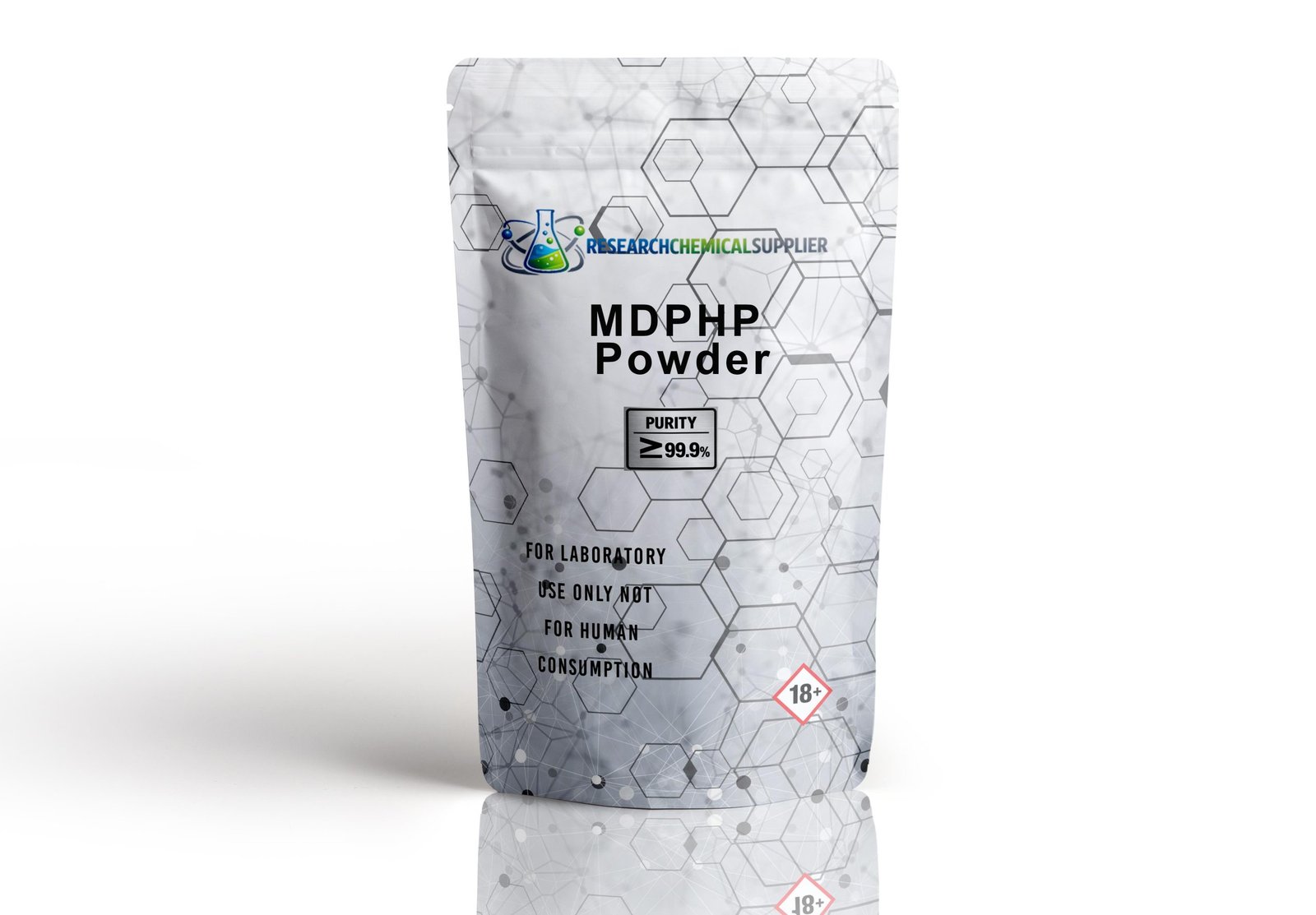
MDPHP (hydrochloride) — formally known as 3′,4′-Methylenedioxy-α-pyrrolidinohexiophenone hydrochloride or 1-(1,3-benzodioxol-5-yl)-2-(pyrrolidin-1-yl)hexan-1-one hydrochloride — is a synthetic cathinone compound belonging to the pyrrolidine-substituted class. This research chemical has emerged as a novel psychoactive substance (NPS) of interest in forensic and pharmacological research due to its structural similarity to other well-known pyrrolidine cathinones.
MDPHP features a methylenedioxy ring substitution pattern similar to MDPV (3′,4′-methylenedioxypyrovalerone) but incorporates a hexyl side chain rather than a propyl chain, resulting in distinct physicochemical and pharmacological properties. This product is supplied as a high-purity crystalline powder, serving as an analytical reference standard for research applications including mass spectral analysis, method development, and in vitro pharmacological studies.
Chemical Identity
| Property | Details |
|---|---|
| IUPAC Name | 1-(1,3-Benzodioxol-5-yl)-2-(pyrrolidin-1-yl)hexan-1-one hydrochloride |
| CAS Number | 2394687-34-0 |
| Molecular Formula | C₁₇H₂₃NO₃ · HCl |
| Molecular Weight | 325.8 g/mol |
| Form | Crystalline powder |
| Synonyms | MDPHP, Methylenedioxy-α-pyrrolidinohexiophenone, 3′,4′-Methylenedioxy-α-pyrrolidinohexiophenone, MD-PHP |
Structural Characteristics
MDPHP belongs to the pyrrolidine-substituted cathinone family, characterized by:
-
Methylenedioxy ring: A 1,3-benzodioxole group attached to the aromatic ring, similar to MDPV and MDMA
-
Pyrrolidine ring: A five-membered nitrogen-containing ring at the α-position
-
Hexyl side chain: A six-carbon alkyl chain extending from the α-carbon, distinguishing it from shorter-chain analogs
This structural configuration places MDPHP within the broader class of synthetic cathinones often referred to as “bath salts” in forensic literature.
Research & Forensic Applications
MDPHP has been identified in seized drug samples and is the subject of ongoing analytical and pharmacological research. Key research applications include:
Forensic Drug Analysis
Serves as a reference standard for identifying MDPHP in seized samples using gas chromatography-mass spectrometry (GC-MS), liquid chromatography-tandem mass spectrometry (LC-MS/MS), and Fourier-transform infrared spectroscopy (FTIR). The compound produces characteristic fragmentation patterns useful for isomer differentiation and confirmation.
Analytical Method Development
Enables forensic laboratories to develop and validate detection methods for pyrrolidine-substituted cathinones in biological matrices and seized materials. MDPHP is often included in synthetic cathinone screening panels for comprehensive NPS identification.
Pharmacological Research
Studies indicate that pyrrolidine-substituted cathinones like MDPHP act as potent dopamine and norepinephrine reuptake inhibitors. Research applications include transporter binding assays, in vivo behavioral studies, and structure-activity relationship (SAR) investigations.
Metabolite Identification
Serves as a reference standard for identifying phase I and phase II metabolites in hepatocyte or microsome studies, supporting toxicological research and interpretation.
Technical Specifications
| Parameter | Detail |
|---|---|
| Purity | ≥98% (analytical standard grade) |
| Storage Conditions | -20°C (recommended for long-term stability) |
| Physical Appearance | Off-white to white crystalline powder |
| Solubility | Soluble in DMSO, methanol, and ethanol |
| Stability | Stable for at least 12 months when stored desiccated at -20°C |
Analytical Data
For analytical method development, MDPHP produces characteristic electron ionization (EI) mass spectral fragments:
-
Base peak: Typically observed at m/z 112 (pyrrolidinium ion)
-
Major fragments: m/z 149 (methylenedioxybenzoyl cation), m/z 121, and m/z 84
-
Molecular ion: m/z 289 (free base) or 325 (hydrochloride salt)
These fragmentation patterns are consistent with other pyrrolidine-substituted cathinones and aid in isomer differentiation.
Regulatory Status
MDPHP is recognized as a synthetic cathinone of concern by international forensic and public health authorities. It has been identified in the global illicit drug market and is subject to monitoring under various early warning systems. Researchers should verify the regulatory status of this compound in their jurisdiction prior to procurement, as it may be classified as a controlled substance in many countries.
Important Safety Notice
This product is strictly intended for research and forensic applications only. It is:
-
NOT for human or veterinary use
-
NOT an FDA-approved drug or medicine
-
NOT for therapeutic, diagnostic, or in vivo applications in humans
-
For laboratory use only by qualified researchers
Researchers handling this compound must observe appropriate laboratory safety protocols, including the use of personal protective equipment (PPE), proper chemical hygiene practices, and adherence to institutional safety guidelines. A safety data sheet (SDS) is available upon request.
Related Analytical Standards
For comprehensive synthetic cathinone analysis, MDPHP is often used alongside related reference standards including:
-
MDPV (3′,4′-Methylenedioxypyrovalerone)
-
α-PVP (α-Pyrrolidinopentiophenone)
-
4F-α-PVP (4-Fluoro-α-pyrrolidinopentiophenone)
-
3,4-MD-α-PVP (3,4-Methylenedioxy-α-pyrrolidinopentiophenone)


Reviews
There are no reviews yet.