
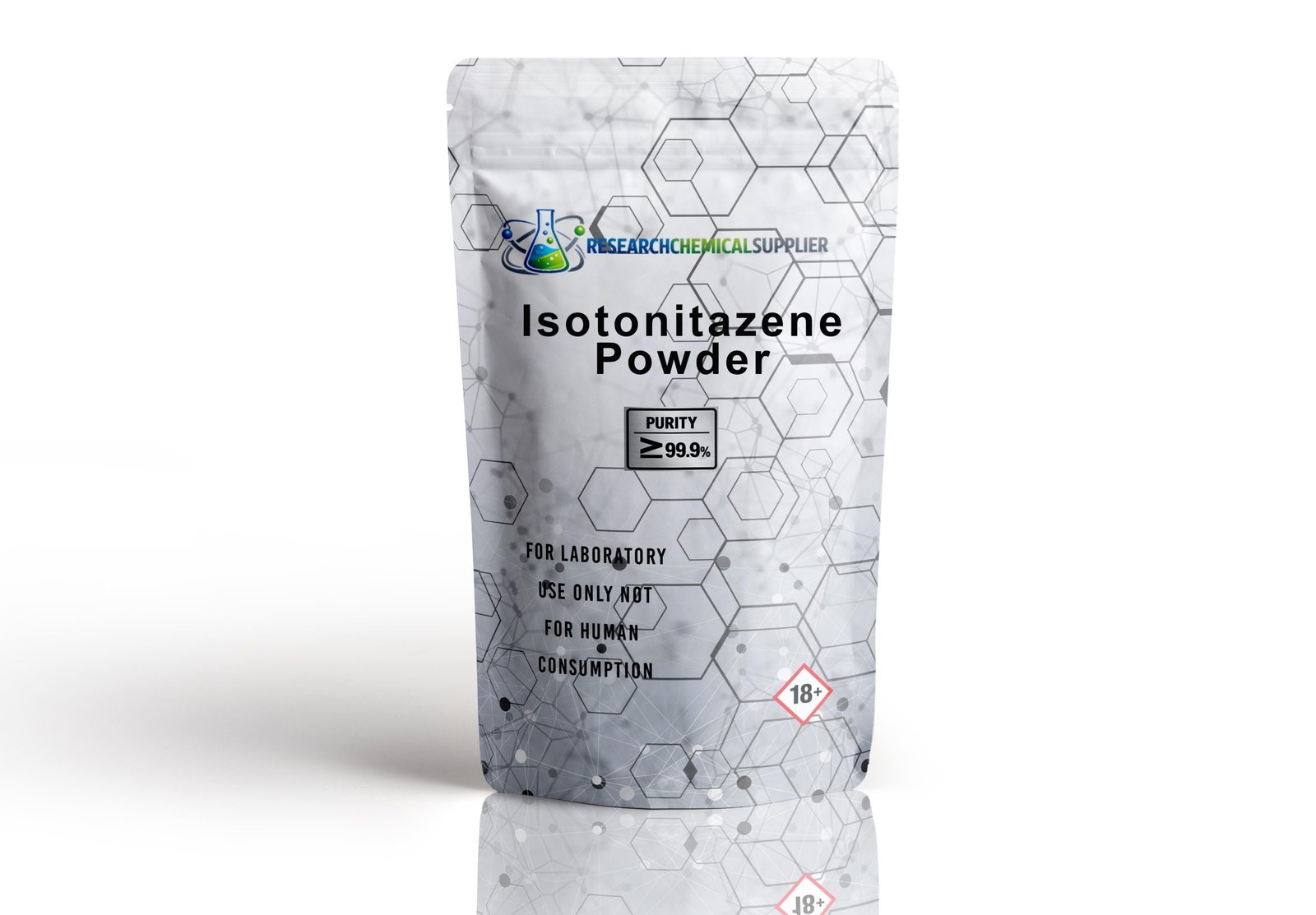
Buy Isotonitazene Powder Online
Isotonitazene is a highly potent synthetic opioid belonging to the 2-benzylbenzimidazole class (nitazenes). It was first synthesized in the 1950s by the pharmaceutical research department of Ciba AG as part of an investigation into structure-activity relationships for analgesic compounds . However, it was never approved for medical use due to its narrow therapeutic window and pronounced risk of respiratory depression . Today, Isotonitazene is exclusively utilized as a certified reference material for analytical and forensic toxicology applications.
This product is classified as a DEA Schedule I controlled substance in the United States and is listed in Schedule I of the UN Single Convention on Narcotic Drugs .
2. Key Chemical & Physical Properties
-
IUPAC Name: N,N-diethyl-2-[2-({4-[(propan-2-yl)oxy]phenyl}methyl)-5-nitro-1H-benzimidazol-1-yl]ethan-1-amine
-
Form: Solid powder (freebase); also available as hydrochloride salt
-
Melting Point (Hydrochloride): 172–173 °C
-
Solubility: Soluble in methanol, chloroform, and DMSO; salts are expected to be sufficiently water-soluble for injectable administration
-
LogP (Lipophilicity): 4.85 (calculated)
-
Appearance in Seized Samples: Brown, yellow, and white powders; also identified in liquid form
3. Pharmacological Profile
Isotonitazene acts as a highly potent mu-opioid receptor (MOR) agonist and has been characterized as a superagonist .
-
Potency: In pre-clinical studies (mice), Isotonitazene demonstrated approximately four times the analgesic potency of fentanyl, with affinity at the mu-opioid receptor approximately 10 times higher than fentanyl .
-
Mechanism: It activates Gi-protein signaling pathways and recruits β-arrestin-2 . Isotonitazene exhibits a preference for the G-protein pathway over the β-arrestin-2 pathway, but notably can cause GPCR kinase-independent β-arrestin recruitment .
-
Onset & Duration: The drug induces rapid-onset, long-lasting respiratory depression, which is dose-dependent and can be life-threatening even at sub-milligram doses .
-
Antagonist: Naloxone blocks Isotonitazene’s activation of the mu-opioid receptor .
4. Regulatory & Legal Status
Due to its high abuse potential and lack of accepted medical use, Isotonitazene is strictly controlled worldwide:
-
United States: DEA Schedule I controlled substance. The DEA issued an emergency scheduling order in August 2020, which was made permanent effective December 6, 2021 .
-
International: Recommended for Schedule I of the UN Single Convention on Narcotic Drugs (1961) by the WHO Expert Committee on Drug Dependence .
-
Germany: Listed in Annex II of the Narcotics Act (BtMG) since May 22, 2021 (verkehrsfähiges, aber nicht verschreibungsfähiges Betäubungsmittel) .
-
Canada & UK: Controlled as a benzimidazole-opioid class substance .
Note: Related substances, including N-desethyl isotonitazene (an active metabolite), have also been permanently placed in Schedule I effective January 22, 2026 .
5. Forensic & Research Applications
This product is intended for in vitro laboratory research, forensic analysis, and clinical toxicology only. Not for human or veterinary use.
-
Analytical Reference Standard: Used as a certified reference material (CRM) for the identification and quantification of nitazenes in biological matrices (blood, urine) and seized materials .
-
LC-MS/MS & GC-MS: Isotonitazene has a detection limit of 0.1 ng/ml and a quantification limit of 0.5 ng/ml using liquid chromatography-mass spectrometry . It is not detected by standard immunoassay-based drug tests .
-
Metabolite Identification: Key biomarkers for toxicological testing include:
-
In urine: N- and O-dealkylation products .
-
In blood: 5-Aminoisotonitazene (formed by reduction of the nitro group), which is detected in most blood samples .
-
Active Metabolite: N-Desethyl isotonitazene also exhibits superagonist activity .
-
-
Pharmacological Research: Used to study structure-activity relationships of benzimidazole-opioids, G-protein signaling bias, and mechanisms of opioid-induced respiratory depression .
6. Safety & Hazard Information (GHS)
-
Signal Word: Danger
-
Hazard Statements:
-
H370: Causes damage to organs
-
H225: Highly Flammable liquid and vapour (for methanolic solutions)
-
-
Precautionary Statements:
-
P260: Do not breathe dust/fume/gas/mist/vapours/spray
-
P264: Wash hands thoroughly after handling
-
P270: Do not eat, drink or smoke when using this product
-
P280: Wear protective gloves/protective clothing/eye protection/face protection
-
P301+P310: IF SWALLOWED: Immediately call a POISON CENTER or doctor/physician
-
P307+P311: IF exposed: call a POISON CENTER or doctor/physician
-
P405: Store locked up
-
7. Storage & Handling
-
Storage Temperature: -20°C (long-term stability ≥ 1 year)
-
Formulation: Available as a neat solid or as a 1 mg/ml solution in methanol
-
Stability: Stable for at least 1 year when stored at -20°C
Disclaimer: This information is for scientific and educational reference only.




Reviews
There are no reviews yet.